Drift Tengoku — October 2003
Drag a corner or click a page to turn it
About this issue
English draft translations are available throughout this issue. Unclear or unreadable OCR remains flagged; these drafts have not received full image proofreading. The archive retains 310 scan files, including two duplicate captures, representing 308 unique pages.
Page 38 · English draft
Draft translation. Unclear OCR remains flagged; full image proofreading has not been performed.
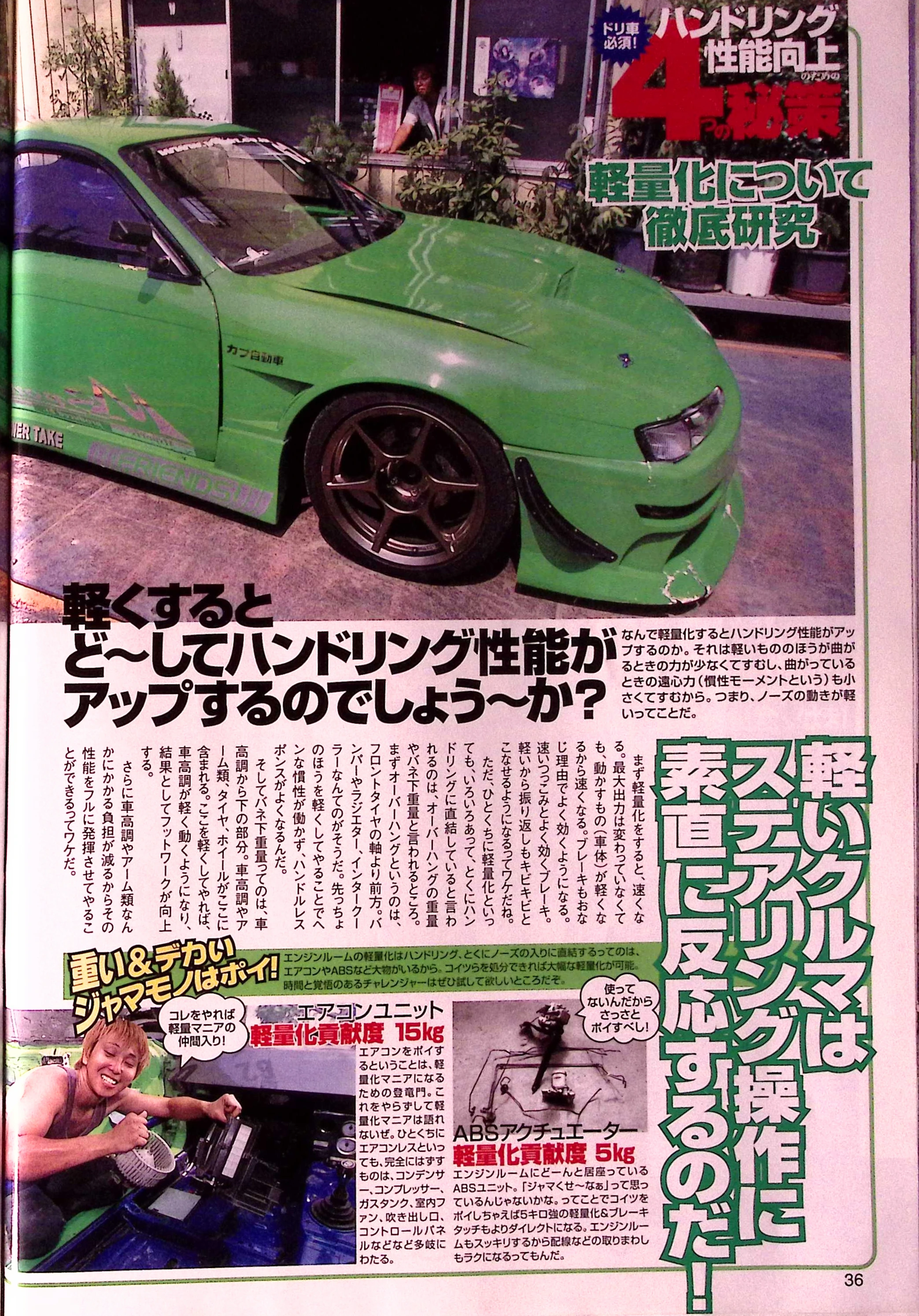
- Drift cars
- Handling
- Essential!
- Secret techniques [stray OCR character]
- Performance improvement
- About weight reduction
- Thorough investigation
- カフ Jidosha [company name OCR uncertain]
- ERTAKE
- Why does making a car lighter improve its handling?
- Why does reducing weight improve handling? A lighter object needs less force to turn and develops less centrifugal force while turning—the text calls this “moment of inertia.” In other words, the nose moves more lightly. [technical terminology as printed/OCR; review separately]
- Steeri… [fragment]
- A light car responds obediently
- First, reducing weight makes a car faster. Even without changing maximum power, the object being moved—the body—is lighter. Brakes also work better for the same reason. Faster entry, more effective braking, and brisk transitions thanks to the lower weight. But weight reduction comes in different forms. Overhang weight and unsprung weight are said to have especially direct effects on handling. The front overhang is ahead of the front axle: bumpers, radiator and intercooler are examples. Reducing weight at the nose reduces unwanted inertia and improves steering response. Unsprung weight means components below the suspension springs; the article includes coilovers, arms, tires and wheels. Making this area lighter helps suspension movement and thus improves its response. It also reduces the load on coilovers and arms so they can deliver their full performance. [technical simplifications and OCR require source review]
- [Unclear: corrupted label]
- Heavy and bulky…
- …things in the way: throw them out!
- Weight reduction in the engine bay directly improves handling, especially turn-in, because it contains large items such as air conditioning and ABS. Removing them can save considerable weight. The article encourages those with the time and commitment to try it. [OCR damaged]
- Do this and join the weight-reduction fanatics…
- Contribution to weight reduction
- Air-conditioning unit [OCR damaged]
- 15kg
- …since you are not using it, discard it!
- Quickly…
- …using… [fragment]
- …operation… [fragment]
- …join their ranks!
- Removing the air conditioning is the gateway to becoming a weight-reduction fanatic; without doing it, you cannot really claim the title. Fully deleting it involves many components: condenser, compressor, gas tank, cabin fan, vents and control panel, among others. [OCR interleaves the neighboring ABS paragraph here.] Removing the ABS unit saves a little over 5 kg and makes brake-pedal feel more direct. It also clears the engine bay and makes routing wiring easier. [column order must be checked visually]
- ABS actuator — weight saving: 5 kg
- The ABS unit occupies a large area in the engine bay. You may have thought, “What a nuisance…” [continued]
- …a wide range of parts. [continuation of air-conditioning list]
- …becomes easier too. [continued]
- 36