Drift Tengoku — October 2003
Drag a corner or click a page to turn it
An archive project by Flock MFGNew issue alerts →
About this issue
This October 2003 issue follows street and competition drift builds, driver teams, and tuning parts, with shop features on Silvias and other FR cars. Its coverage ranges from event battles and setup choices to the practical components used to gain steering angle and control.
Page 64 · English draft
Draft translation. Unclear OCR remains flagged; full image proofreading has not been performed.
- 1. Ultra-low-cost idea modifications
- 2. It really worked!
- 3. Cooling improvements
- 4. BEST 50 — Student Championship
- 5. #31
- 6. Turn the electric fan on with a switch!
- 7. Naoki Kawabata
- 8. Cefiro
- 9. A31
- 10. #
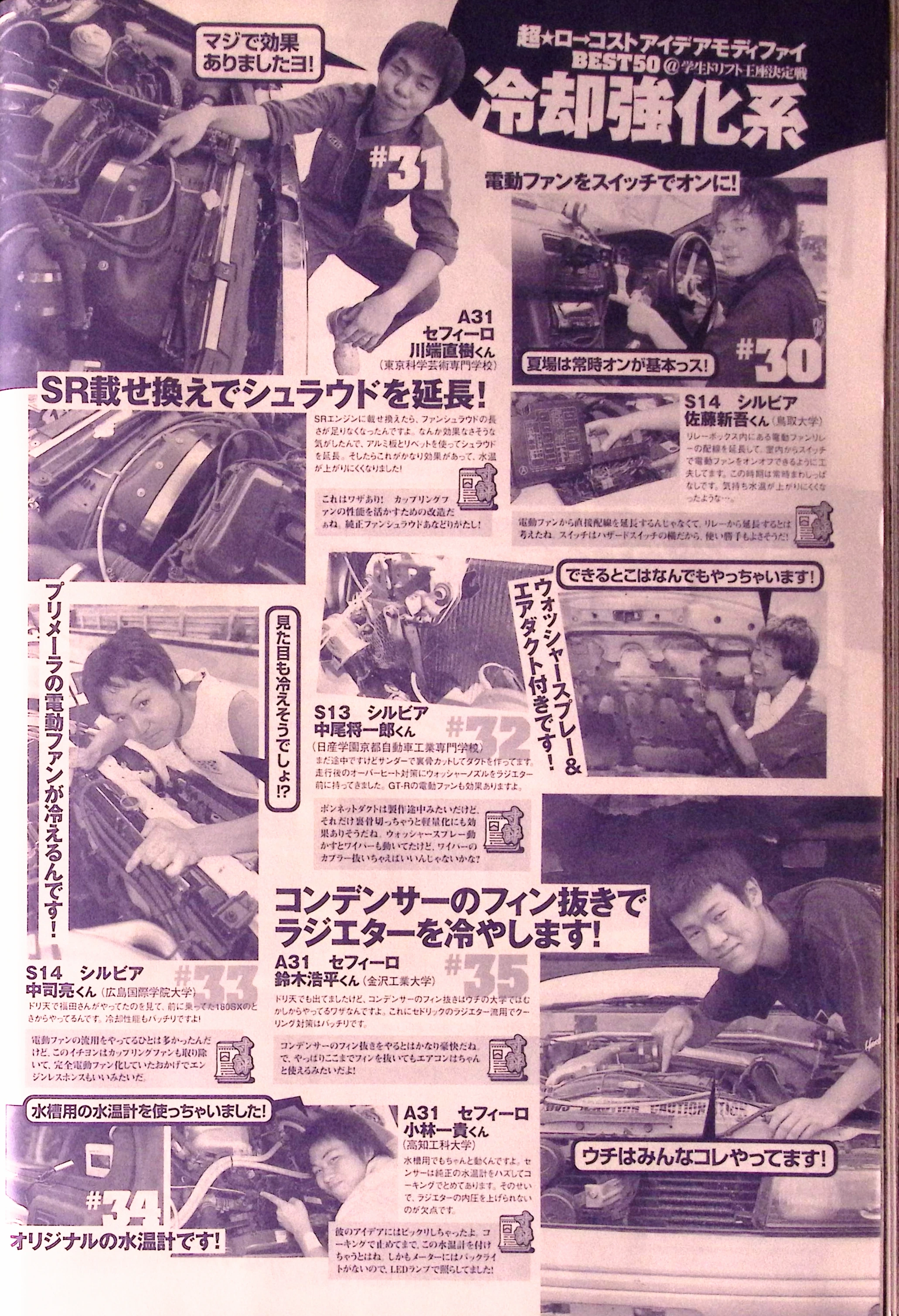
- 11. 30
- 12. Extended the shroud after an SR swap!
- 13. (Tokyo science/arts technical school, name as OCR)
- 14. In summer, keeping it on is the starting point!
- 15. S14
- 16. Silvia
- 17. After swapping in an SR engine, the fan shroud was too short. It did not seem effective, so I extended it with aluminum sheet and rivets. It worked, and coolant temperature became less prone to rising.
- 18. Shingo Sato (Tottori University)
- 19. I extended the electric-fan relay wiring from the relay box so I can switch the fan on and off from inside. At this time of year I keep it on; coolant temperature seems a little less prone to rising.
- 20. A clever idea! A modification that makes use of the fan’s ability. The factory shroud deserves respect!
- 21. Coupling… [fragment]
- 22. …seems to have… [fragment]
- 23. Extend the wiring from the relay rather than directly from the electric fan. The switch beside the hazard switch also looks convenient.
- 24. Washer spray
- 25. The Primera electric fan cools well!
- 26. I do everything I can!
- 27. It looks as though it will cool well, doesn’t it?
- 28. S13 Silvia — Shoichiro Nakao (Nissan Kyoto automobile technical school, name as OCR) . It is still in progress, but I am cutting the hood’s inner framework and making ducts with a grinder. To prevent overheating after driving, I moved the washer nozzle ahead of the radiator. A GT-R electric fan is effective too.
- 29. #
- 30. The hood duct is still being made, but removing so much framework should save weight. The wipers moved when the washer spray was activated; perhaps simply unplugging the wiper connector would solve that?
- 31. Removing condenser fins cools the radiator! 浩平 [name/institution fragment corrupted]
- 32. S14
- 33. Silvia
- 34. #
- 35. Kohei Suzuki (Kanazawa Institute of Technology)
- 36. A31
- 37. Cefiro
- 38. #
- 39. 亮 Nakatsukasa (Hiroshima Kokusai Gakuin University)
- 40. I saw Fukuda do it in Drift Tengoku and have done it since my previous 180SX. Cooling performance is good too!
- 41. It is a trick I have used for a long time. Combined with an adapted Cedric radiator, cooling measures are well covered.
- 42. Many people adapt electric fans, but this S14 also removed the viscous-coupling fan for a fully electric setup. Engine response seems good as a result.
- 43. Removing this many condenser fins is bold! Apparently the air conditioning still works properly even with so many removed.
- 44. Used an aquarium thermometer!
- 45. A31
- 46. Kazuki Kobayashi (Kochi University of Technology) . It is an aquarium unit. I removed the factory coolant-temperature sender and sealed this sensor in with caulk. The drawback is that radiator internal pressure cannot be raised…
- 47. Cefiro
- 48. Everyone in our group does this!
- 49. An original coolant-temperature gauge!
- 50. #34V
- 51. His idea surprised us—installing this gauge with caulk! It has no backlight, so an LED lamp illuminates it.
- 52. …that is the drawback. [continued]