Drift Tengoku — October 2003
Drag a corner or click a page to turn it
About this issue
English draft translations are available throughout this issue. Unclear or unreadable OCR remains flagged; these drafts have not received full image proofreading. The archive retains 310 scan files, including two duplicate captures, representing 308 unique pages.
Page 175 · English draft
Draft translation. Unclear OCR remains flagged; full image proofreading has not been performed.
- PIRIEISIENIT
- WIIININIERIS
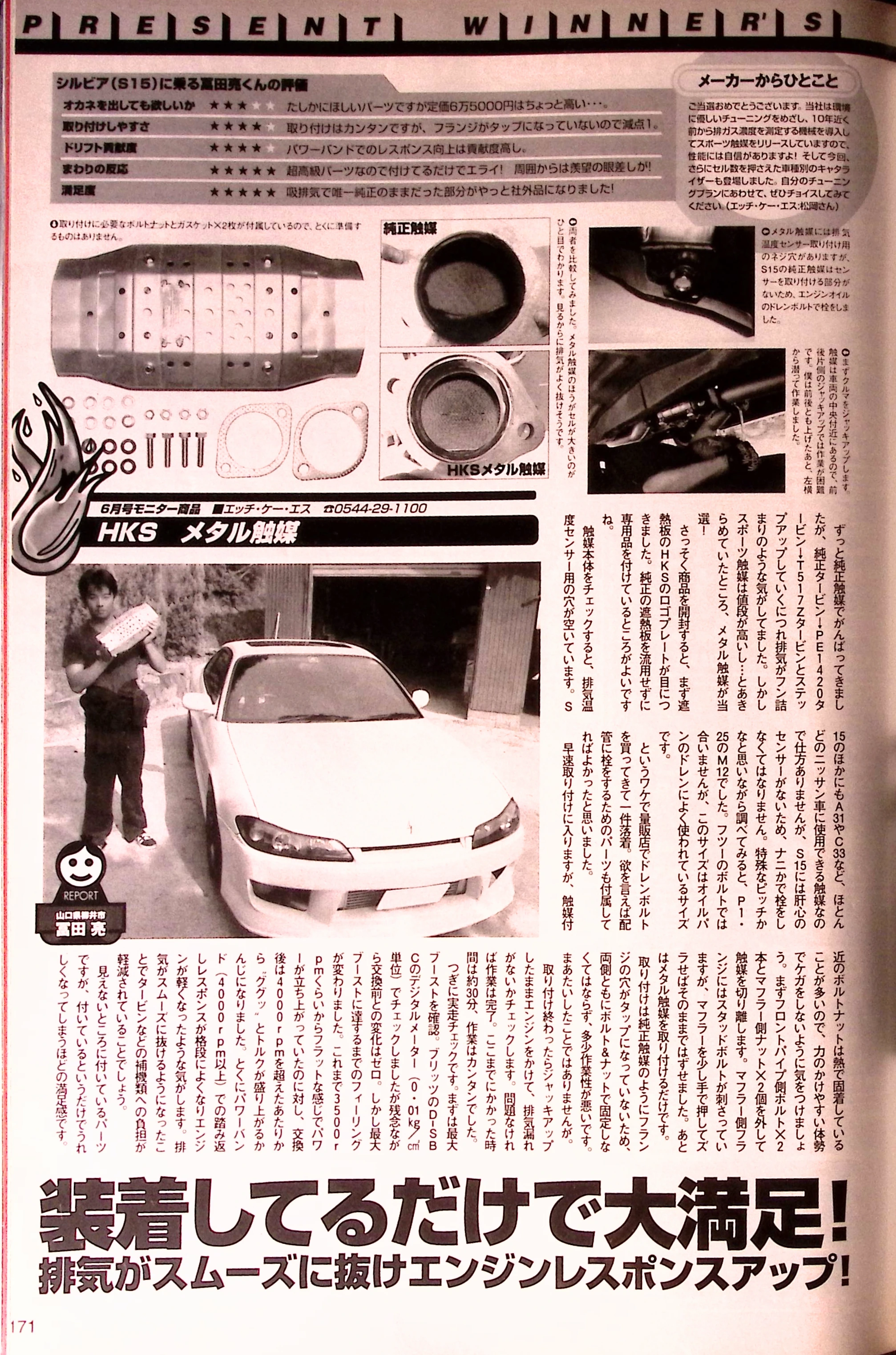
- Ryo Tomita's ratings, Silvia S15 owner: Would you buy it with your own money? / Ease of installation / Contribution to drifting / Other people's reactions. [Name fragment checked against adjacent text.]
- A word from the manufacturer
- Five stars / five stars
- I definitely want this part, but the list price of ¥60,500 is a little expensive. Installation is easy, but I deducted one point because the flanges aren't tapped. Better response in the power band contributes a lot. It's such a high-end part that simply having it fitted feels special—everyone looks at it enviously! The only part of my intake and exhaust that was still standard has finally become aftermarket.
- Congratulations on winning! We aim for environmentally friendly tuning. Nearly ten years ago we introduced equipment to measure exhaust concentrations and began offering sports catalytic converters, so we're confident in their performance. We've now also introduced vehicle-specific catalyzers with further reduced [emissions; exact OCR wording damaged]. Please choose the one that suits your tuning plans. —Matsuoka, HKS
- Satisfaction
- Five stars / five stars
- Five stars
- Comparing the two, you can immediately see that the metal catalytic converter's cells are larger. It looks as though exhaust will flow through much more freely.
- The bolts, nuts and two gaskets needed for installation are included, so there is nothing special
- you need to prepare.
- Standard catalytic converter
- The metal catalytic converter has a threaded hole for an exhaust-temperature sensor. The S15's standard converter has no sensor fitting, so I plugged the hole with an engine-oil drain bolt.
- First I jacked up the car. Because the converter is near the center, raising just one front side makes the work difficult. I raised both the front and rear and worked from underneath. [OCR partly damaged.]
- I did. [End of the adjacent caption.]
- ππTπ
- HKS metal catalytic converter
- I'd kept the standard catalytic converter all along. As I upgraded from the standard turbo to a PE1420 and then a T517Z, the exhaust increasingly felt restricted. But sports catalytic converters were expensive, so I'd given up—then I won a metal catalytic converter!
- Opening the package, the first thing I noticed was the HKS logo plate on the heat shield. I liked that it came with a dedicated shield rather than reusing the standard one.
- Checking the converter itself, I found a hole for an exhaust-temperature sensor. Besides the S
- June issue product-test prize
- HKS
- Telephone: 0544-29-1100
- [Unclear isolated fragment.]
- Winner!
- HKS
- HKS metal catalytic converter
- Metal catalytic converter
- 15, it fits most Nissan cars, including the A31 and C33, so that's understandable. But the S15 doesn't have the sensor, meaning I had to plug the hole. I wondered whether the thread pitch was unusual; it turned out to be M12, 1.25 pitch. An ordinary bolt wouldn't fit, but that's a size commonly used for oil-pan drain plugs.
- I bought a drain bolt at an auto-parts store and solved the problem. If I were being picky, I'd have liked a plug included. I then started the installation. The bolts and nuts around the catalytic
- is. [End of the adjacent caption.]
- REPORT
- Ryo Tomita
- Yanai-shi, Yamaguchi [OCR partly damaged.]
- converter often seize from heat, so use a position that lets you apply force safely without injuring yourself. First I removed the two front-pipe bolts and the two exhaust-side nuts, separating the converter. The exhaust-side flange has stud bolts, but by pushing the exhaust slightly aside by hand I could remove it. Then I fitted the metal converter. Unlike the standard converter, its flange holes aren't tapped, so both sides need bolts and nuts; that makes installation slightly less convenient, though it's no big deal. Once fitted, I started the engine with the car still raised and checked for exhaust leaks. If there are none, the job is finished. It took about 30 minutes and was easy. Next came the driving test. First I checked maximum boost using the digital gauge on my BLITZ [controller model and display increment damaged]. Unfortunately there was no change in maximum boost. But the feeling on the way to maximum boost changed. Previously, power came in fairly flatly from around 3,500 rpm. After replacement, torque swelled strongly once it passed about 4,000 rpm. Throttle reapplication response was especially better in the power band above 4,000 rpm, and the engine felt freer. Smoother exhaust flow should also reduce the load on the turbo and other auxiliary equipment. You can't see this part once it's fitted, but just knowing it's there gives me tremendous satisfaction.
- Just having it installed makes me completely satisfied!
- Smoother exhaust flow improves engine response!
- 171