Drift Tengoku — October 2003
Drag a corner or click a page to turn it
About this issue
English draft translations are available throughout this issue. Unclear or unreadable OCR remains flagged; these drafts have not received full image proofreading. The archive retains 310 scan files, including two duplicate captures, representing 308 unique pages.
Page 174 · English draft
Draft translation. Unclear OCR remains flagged; full image proofreading has not been performed.
- MIPIRIE|S|SIIO|N|R|EIPIOIRIT
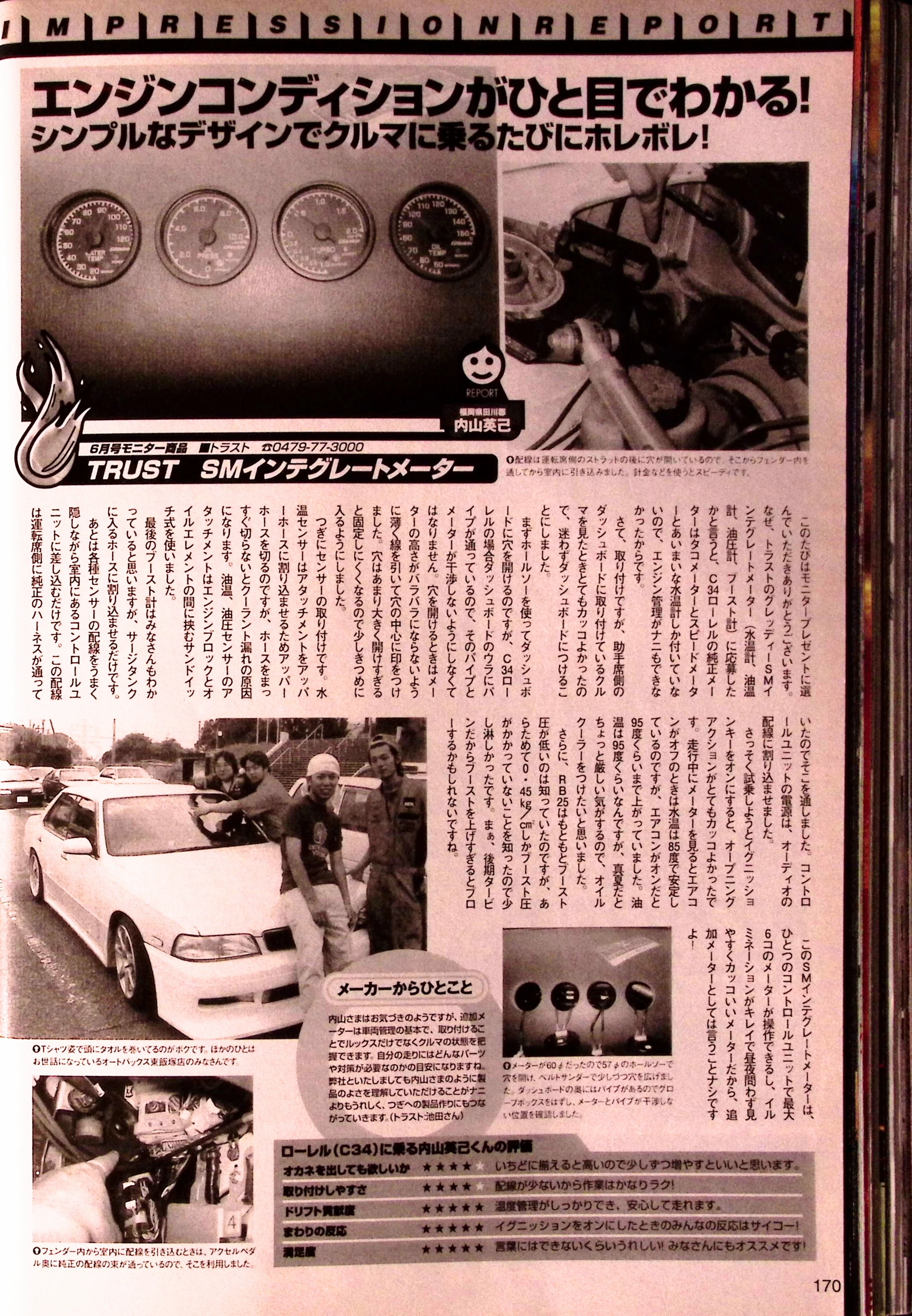
- See your engine's condition at a glance! The simple design makes me fall in love with it every time I get into the car!
- 6D
- 70
- 80
- 90
- 100
- 110
- 120
- 8
- 100
- 110
- 10
- 130
- 160
- 50
- 20
- REPORT
- June issue product-test prize. TRUST: 0479-77-3000 [OCR partly damaged.]
- Hideki Uchiyama [Given-name reading provisional.]
- Tagawa district, Fukuoka [OCR partly damaged.]
- TRUST SM Integrated Meter
- There is a hole behind the driver's-side strut; I routed the wiring through it, inside the fender and into the cabin. [OCR partly damaged.]
- Using wire as a guide makes it quicker.
- Thank you for choosing me for the product-test giveaway. I wanted TRUST's GReddy SM Integrated Meters—water temperature, oil temperature, oil pressure and boost—because my C34 Laurel's standard instruments only included a tachometer, speedometer and vague water-temperature gauge. I couldn't monitor the engine properly. As for installation, I had seen another car with the gauges on the passenger side of the dashboard and thought it looked great,
- [Unclear duplicate or damaged sentence fragment.]
- so I decided to do the same. First I used a hole saw to cut the dashboard. On the C34 Laurel a pipe runs behind the dashboard, so the gauges must be positioned to avoid it. I lightly drew a line and marked the hole centers so the gauges would sit at the same height. If the holes are too large, securing the gauges becomes difficult, so I made them a slightly tight fit. Next came the sensors. For the water-temperature sensor, I cut the upper hose and inserted an adapter. The hose must be cut straight, otherwise coolant can leak. For the oil-temperature and oil-pressure sensors I used a sandwich adapter between the engine block and oil filter. Lastly, for the boost gauge, as you probably know, you simply tap into the hose going to the surge tank. Then you hide each sensor's wiring neatly and connect it to the control unit inside the cabin. The factory harness ran through the driver's side,
- [Unclear damaged caption fragment.]
- so I followed that route. I tapped into the audio wiring for the control unit's power supply. When I turned on the ignition to try it out, the opening sequence looked fantastic. Looking at the gauges while driving, water temperature was steady with the air conditioning off, but rose when it was on. Oil temperature also made me think summer would be demanding, so I wanted to fit an oil cooler. [Temperature figures are corrupted in the OCR and require visual checking.] I knew the RB25's standard boost was low, but seeing only 0.45 on the gauge again was a little disappointing. Still, with the later-model turbo, raising boost might blow it up.
- One control unit can operate up to six SM Integrated Meters. The illumination is beautiful, they're easy to read day or night, and they look great. As supplementary gauges, I couldn't ask for more.
- 26-
- As Uchiyama has noticed, supplementary gauges are fundamental to vehicle monitoring. Fitting them improves appearance and lets you understand the car's condition. They help you judge which parts or measures suit your driving. Nothing makes us happier than customers like Uchiyama appreciating our products; it encourages us to develop the next ones. —Ikeda, TRUST
- A word from the manufacturer
- I'm the one in the shirt with a towel wrapped around my head. The others are the staff at Autobacs Higashi-Iizuka, who always look after me. [Shirt description damaged.]
- The gauges are 60 mm, so I cut the holes with a 57 mm hole saw and gradually enlarged them with a belt sander. Since a pipe runs behind the dashboard, I removed the glovebox to check where the gauges would clear it.
- Hideki Uchiyama, Laurel C34 owner, gives his ratings: Would you buy it with your own money? ★★★★★ / Ease of installation / Contribution to drifting / Other people's reactions.
- There are fewer wires, so the installation is easier! I can monitor temperatures properly and drive with peace of mind. Everyone's reaction when I turn on the ignition is wonderful! I'm so happy I can hardly put it into words; I recommend them to everyone! [Rating symbols and some wording are damaged.]
- Buying them all at once is expensive, so I think it's best to add them gradually.
- To bring the wiring from inside the fender into the cabin, I used the route taken by the factory wiring bundle behind the accelerator pedal.
- Satisfaction
- 170