Drift Tengoku — October 2003
Drag a corner or click a page to turn it
About this issue
English draft translations are available throughout this issue. Unclear or unreadable OCR remains flagged; these drafts have not received full image proofreading. The archive retains 310 scan files, including two duplicate captures, representing 308 unique pages.
Page 29 · English draft
Draft translation. Unclear OCR remains flagged; full image proofreading has not been performed.
- GET THE GOOD HANDLING!
- In-depth study
- How to build a car that corners
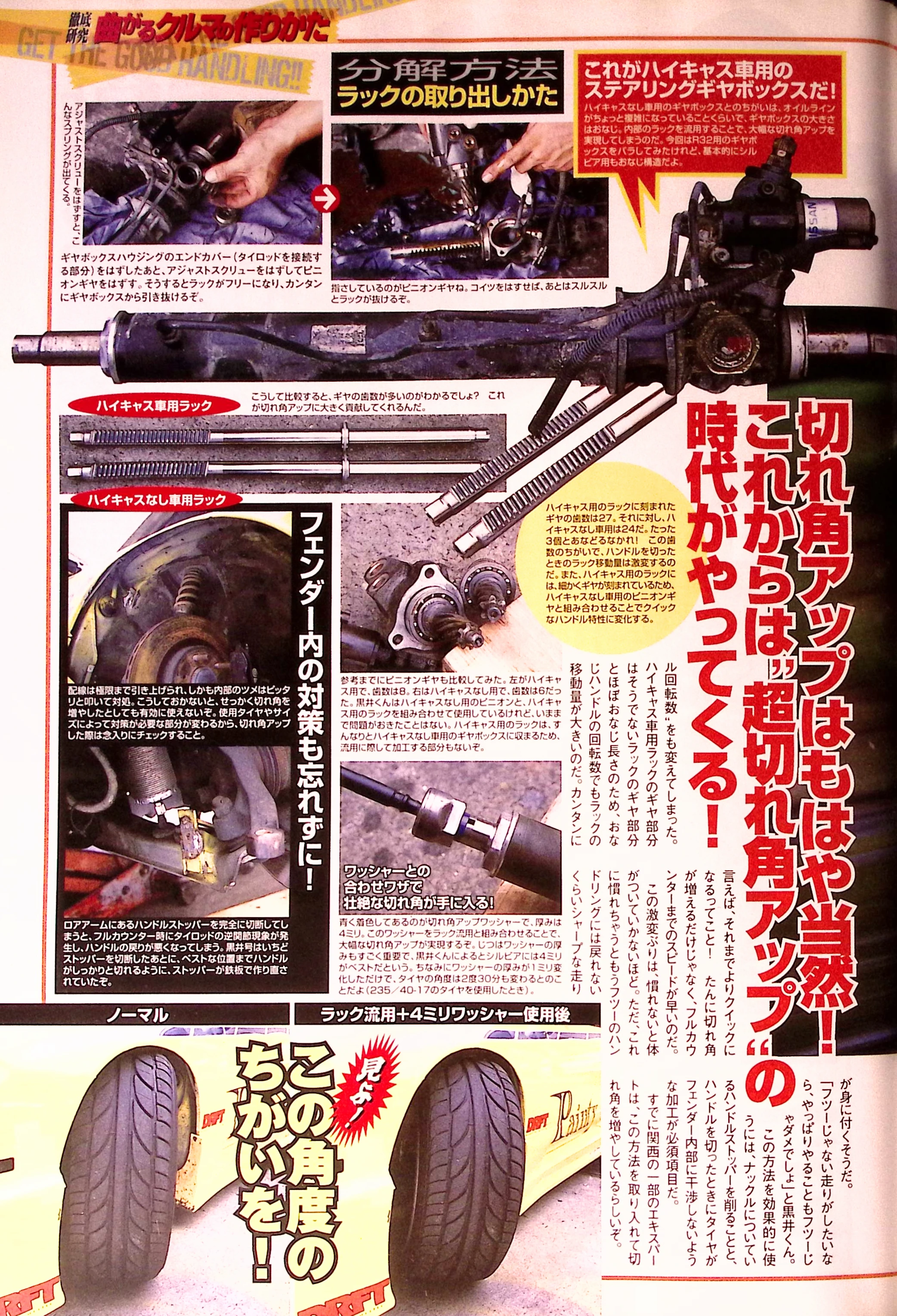
- Disassembly: how to remove the rack
- This is the steering gearbox for a HICAS-equipped car!
- Removing the adjuster screw reveals this spring.
- Compared with a gearbox for a car without HICAS, the oil lines are a little more complicated, but the gearbox itself is the same size. Swapping its internal rack yields a substantial increase in steering angle. We dismantled an R32 gearbox here; the Silvia version has essentially the same construction.
- After removing the gearbox housing’s end cover—the part where the tie rod connects—remove the adjuster screw and pinion gear. The rack is then free and can easily be pulled out of the gearbox.
- The part being pointed to is the pinion gear. Remove it and the rack slides straight out.
- Comparing them like this, you can see the greater number of gear teeth. That contributes greatly to the increased steering angle.
- This… [fragment]
- [Unclear: fragmented decorative heading]
- Rack for a HICAS-equipped car
- An increase in steering angle is now a given… [fragment]
- Simply put, it becomes quicker than before! It does more than increase steering angle: it gets to full countersteer faster. The change is so dramatic that your body cannot keep up until you get used to it. But once you do, it apparently enables such sharp driving that you cannot go back to ordinary handling… [continued]
- Rack for a car without HICAS
- The HICAS rack has 27 teeth, versus 24 on the non-HICAS rack. Do not dismiss the difference as just three teeth: the article says it dramatically changes rack travel when steering. It also explains that the HICAS rack’s finer teeth, combined with a non-HICAS pinion gear, produce quicker steering. [Historical technical claims retained as printed.]
- From here, an extreme increase in steering angle… [heading fragment]
- Do not forget clearance modifications inside the fenders!
- …it also changes how much the steering wheel must rotate. The toothed section of the HICAS rack is almost the same length as the non-HICAS rack’s, so the same steering-wheel rotation produces more rack travel. Simply put… [continued]
- The wiring has been lifted as far as possible and the inner flange hammered flat. Otherwise the extra steering angle cannot be used effectively. The areas needing clearance depend on the tires and their size, so check carefully after increasing steering angle.
- For reference, we compared the pinion gears too. The HICAS pinion on the left has eight teeth; the non-HICAS pinion on the right has six. Kuroi uses the non-HICAS pinion with the HICAS rack and says he has had no problems. The HICAS rack fits directly in the non-HICAS gearbox, requiring no modification for the swap.
- Combine the rack swap with a washer for a tremendous steering angle! The blue steering-angle washer is 4 mm thick. Combining it with the rack swap greatly increases steering angle. Thickness matters: Kuroi says 4 mm is best for a Silvia. He says changing washer thickness by just 1 mm changes tire angle by 2°30′ when using 235/40-17 tires.
- Completely cutting off the lower arm’s steering stop causes the tie rod to go over center at full countersteer, impairing steering return. On Kuroi’s car, the stop was cut off and then remade from steel plate to let the steering turn properly to the best position…
- …that is how the stop had been remade.
- Stock
- After the rack swap plus a 4 mm washer
- …you develop that kind of driving. “If you want extraordinary driving, the work you do cannot be ordinary…” [continued]
- …grinding the steering stop and making changes to prevent the tires from contacting the inside of the fenders when turned are essential. Some experts in Kansai apparently already use this method to increase steering angle. [stop-location wording continued from another region]
- A
- D
- [Unclear: corrupted passage fragment]
- …of… [isolated fragment]
- “…either,” says Kuroi. To use this method effectively, the steering stop attached to the knuckle… [continued; opening clipped]
- DRFT
- Pants
- More steering angle is now a given! The age of extreme steering angle is coming!
- [Continued from page28] …it even changes steering-wheel rotation. The toothed section of the HICAS rack is almost the same length as on the other rack, so the same wheel rotation produces more rack travel. In simple terms, steering becomes quicker. It increases steering angle and reaches full countersteer faster. The change is so dramatic that your body may struggle to keep up until you adjust. Once accustomed to it, however, you develop such sharp driving that ordinary handling feels impossible to return to. “If you want extraordinary driving, what you do cannot be ordinary either,” says Kuroi. To use this method effectively, the article says the steering stop on the knuckle must be ground down and clearance provided so the tire does not contact the inner fender when turned. Some experts in Kansai apparently already use this approach.
- Look at the difference in angle!!