Drift Tengoku — October 2003
Drag a corner or click a page to turn it
About this issue
English draft translations are available throughout this issue. Unclear or unreadable OCR remains flagged; these drafts have not received full image proofreading. The archive retains 310 scan files, including two duplicate captures, representing 308 unique pages.
Page 30 · English draft
Draft translation. Unclear OCR remains flagged; full image proofreading has not been performed.
- Steering-angle tie rods and tie-rod washers
- Drift cars
- Essential!
- Handling
- Performance improvement
- Secret techniques
- …for… [heading fragment]
- [Unclear: isolated heading fragment]
- How increased steering angle works
- Steering wheel [OCR damaged]
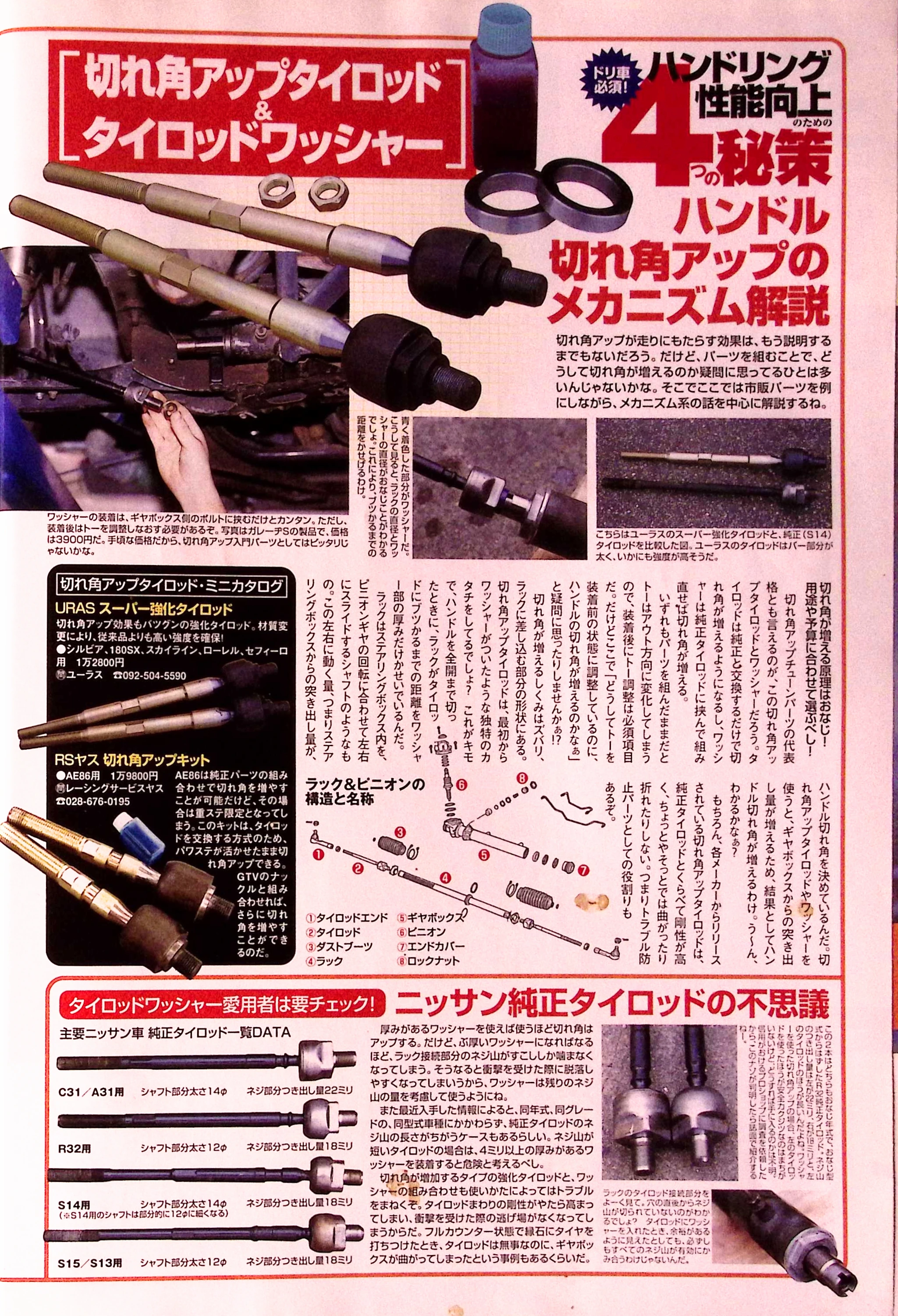
- The driving benefits of increased steering angle hardly need explaining. But many people probably wonder why fitting these parts increases the angle. Here, using commercially available parts as examples, we will focus on explaining the mechanism.
- The blue part is the washer. You can see that its diameter matches the rack’s. This increases the distance before contact occurs. [OCR damaged]
- Installing the washer is simple: sandwich it at the gearbox-side bolt connection. Toe must be adjusted afterward. The product pictured is from Garage S and costs ¥3,900. At this affordable price, it is an ideal introductory part for increasing steering angle… [OCR damaged]
- …wouldn’t you say? [continued]
- This compares the URAS Super Reinforced Tie Rod with a standard S14 tie rod. The URAS rod has a thicker bar and looks clearly stronger.
- For… [fragment]
- URAS
- Telephone: 092-504-5590
- 0c
- RS Yasu steering-angle kit
- [Unclear: isolated character]
- Racing Service Yasu: 028-676-0195
- ● For AE86
- ¥19,800
- Rack-and-pinion construction and component names
- 6
- [Unclear: diagram annotation corrupted as ①00000]
- 8
- 0
- With the GTV knu… [continued]
- -0
- 2
- 8
- 3
- 6
- 5
- …if combined…
- …increase the angle…
- …ckles… [continued]
- …even more steering… [continued]
- 1. Tie-rod end; 2. Tie rod; 3. Dust boot
- ⑤ Gearbox
- 4
- 0
- 0
- 0
- …can… [continued]
- …be done. [continued]
- ④ Rack
- 7. End cover; 8. Locknut
- ⑥ Pinion
- Tie-rod washer users: check this!
- Factory tie-rod reference data
- The thicker the washer used, the greater the steering angle… [continued]
- The mystery of Nissan factory tie rods
- [Unclear: damaged thread-related label]
- Factory tie-rod data for major Nissan models
- ,
- 0
- …requested an inspection… [fragment]
- …then introduce it on this page… [damaged fragment]
- For C31/A31
- Shaft diameter: 14 [unit absent in this fragment]
- Threaded-section projection: 22 mm [unit ending clipped]
- [Unclear: short damaged label]
- Also, recent information suggests that even with the same model year and trim gra… [continued]
- Same
- …de… [fragment]
- For R32
- Shaft diameter: 12 [unit absent in this fragment]
- Threaded-section projection: 18 mm
- Combining reinforced tie rods that increase steering angle with wa… [continued]
- 6
- For S14
- The S14 shaft partly narrows to 12 [unit not printed in fragment; OCR damaged]
- Shaft diameter: 14 [unit absent in this fragment]
- Threaded-section projection: 18 mm [unit clipped]
- Look closely at the rack’s tie-rod connection: the threads do not start immediately inside the hole. Even if sufficient thread appears to remain after fitting a washer, not all of it necessarily engages effectively.
- For S15/S13
- Shaft diameter: 12 [unit absent in this fragment]
- Threaded-section projection: 18 mm [unit clipped]
- The principle is the same: choose tie rods or washers to suit your needs and budget. Replacement steering-angle tie rods increase lock; washers do so by being fitted to the factory tie rods. Both move the toe toward toe-out, so toe adjustment afterward is essential. Why does more lock remain after resetting toe? The key is the shape of the portion entering the rack. An angle-increasing tie rod effectively has a washer-shaped shoulder, adding travel before the rack meets the tie rod. The rack slides side to side as the pinion rotates; how far it protrudes from the steering box determines steering angle. These parts increase that available travel. Aftermarket angle-increasing tie rods are also stiffer than factory items and more resistant to bending or breaking, helping prevent failures. These are the historical article’s explanations.
- Mini catalog: URAS Super Reinforced Tie Rods increase steering angle and use a different material for greater strength than the previous product. For Silvia, 180SX, Skyline, Laurel and Cefiro; ¥12,800. URAS: 092-504-5590. RS Yasu steering-angle kit for AE86: ¥19,800. Racing Service Yasu: 028-676-0195. The article says the factory-parts combination for increasing AE86 lock is limited to manual steering; this replacement tie-rod kit retains power assistance. Combining it with GTV knuckles increases lock further. Prices and applications are as printed in 2003.
- Thicker washers increase angle but reduce engaged thread at the rack, increasing the chance of detachment under impact. Remaining engagement must therefore be considered. The article reports that factory tie-rod thread length can differ even among cars of the same model, year and grade. With short-thread tie rods, it warns that washers 4 mm thick or more are dangerous. Combining reinforced angle-increasing tie rods and washers can also cause problems: excessive stiffness leaves less compliance to absorb impact. It cites a case where striking a curb at full opposite lock left the tie rod intact but bent the steering gearbox.
- Factory Nissan tie-rod dimensions as printed: C31/A31—shaft diameter 14 mm, projecting threaded portion 22 mm. R32—12 mm shaft, 18 mm projection. S14—14 mm shaft, 18 mm projection; part of the S14 shaft narrows to 12 mm. S15/S13—12 mm shaft, 18 mm projection. These measurements do not establish effective thread engagement.