Drift Tengoku — October 2003
Drag a corner or click a page to turn it
About this issue
English draft translations are available throughout this issue. Unclear or unreadable OCR remains flagged; these drafts have not received full image proofreading. The archive retains 310 scan files, including two duplicate captures, representing 308 unique pages.
Page 48 · English draft
Draft translation. Unclear OCR remains flagged; full image proofreading has not been performed.
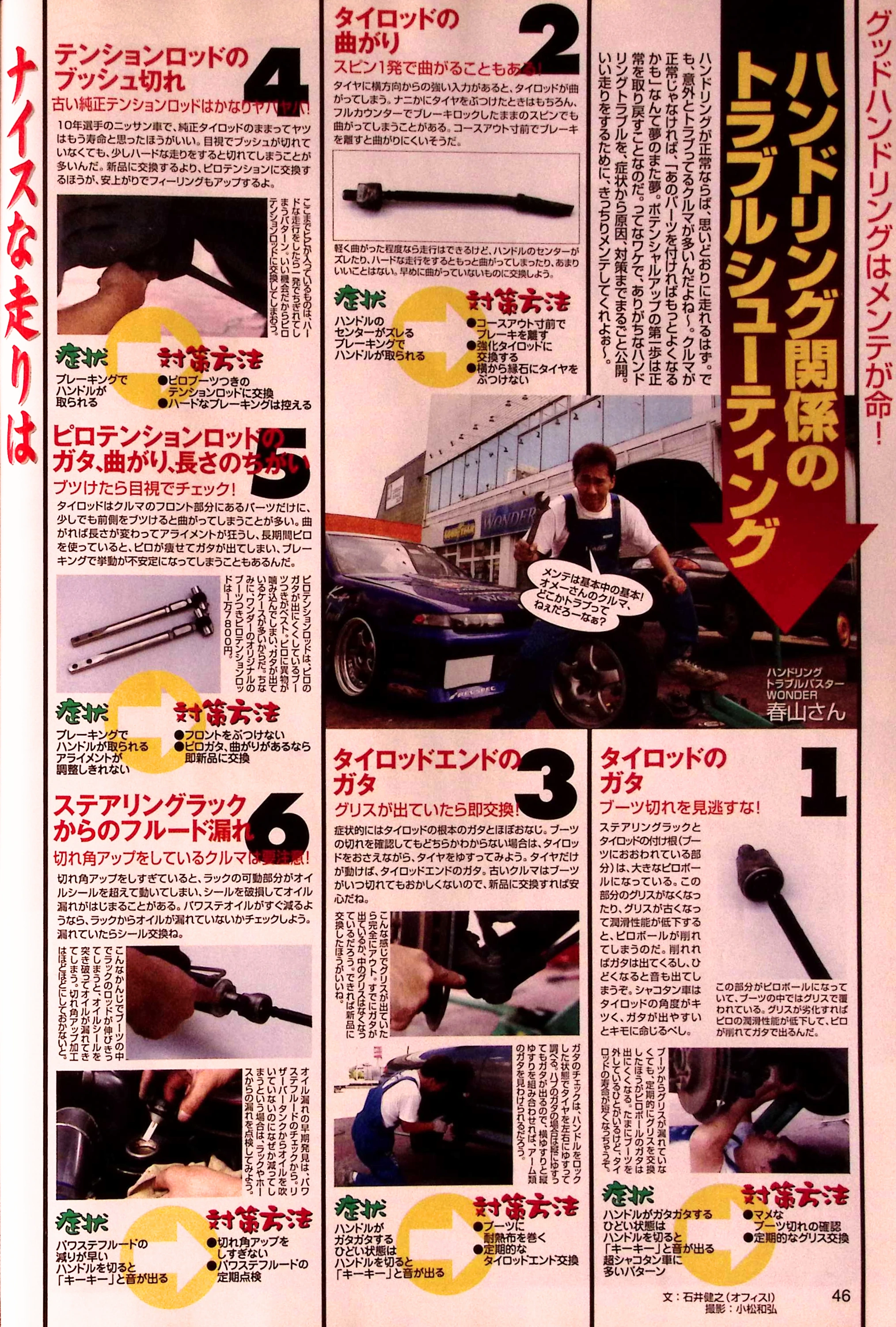
- Maintenance is the key to good handling!
- Bent tie rods. A single spin can bend them.
- [Unclear: damaged tie-rod heading fragment]
- Handling-related…
- …troubleshooting
- With proper handling, the car should go where you want it to. But surprisingly many cars have problems. If the car itself is not healthy, hoping that another part will improve it remains just a dream. Restoring normal condition is the first step toward greater potential. Here we cover common handling troubles, from symptoms and causes to remedies. Maintain the car properly for good driving. [OCR damaged]
- Good driving…
- Split tension-rod bushings. Old factory tension rods can be in very poor condition! On a ten-year-old Nissan still using factory rods [OCR later says tie rods], assume they are near the end of their life. Even if no split is visible, hard driving can split them. Rather than simply buying new factory parts, spherical-bearing tension rods may be cheaper and improve feel. [component wording OCR inconsistent]
- …can bend. Besides striking something with the tire, a spin with the brakes locked at full countersteer can also bend them. Releasing the brakes just before leaving the course apparently makes bending less likely. [OCR damaged; continued]
- A bushing cracked this badly can split in one hard-driving session. Take the opportunity to replace it with a spherical-bearing tension rod. [OCR damaged]
- A slightly bent rod may still permit driving, but can shift the steering center or bend further under hard driving. Replace it promptly with a straight one.
- Symptoms [OCR damaged]
- Remedies
- Symptoms
- Remedies
- The steering wheel…
- …is off-center; steering pulls under braking.
- Release the brakes just before leaving the course; fit reinforced tie rods; avoid hitting curbs sideways with the tires. [OCR damaged]
- Under braking…
- …pulls
- The steering wheel…
- Replace with boot-protected spherical-bearing tension rods. Avoid hard braking. [OCR damaged]
- Replace
- …is… [fragment]
- Play, bending or unequal lengths in spherical-bearing tension rods. Inspect visually after an impact! These rods are at the front of the car and can bend even with a light frontal impact. Bending changes length and disrupts alignment. Long use can wear the spherical bearing and create play, making the car unstable under braking. [OCR calls one occurrence a tie rod; verify component]
- IDER
- Boot-protected spherical-bearing tension rods are best for reducing bearing wear and play. If foreign matter enters the bearing… [continued; OCR damaged]
- [Unclear: clipped fragment]
- …there are many cases… [fragment]
- For reference, Wonder’s boot-protected spherical-bearing tension rods cost ¥17,800.
- Your car isn’t having trouble somewhere, is it?
- Maintenance is fundamental! Somewhere there may be trouble…
- …original… [fragment]
- …many… [fragment]
- …by the way… [fragment]
- Symptoms
- Remedies
- Haruyama
- Handling trouble buster
- WONDER
- Steering pulls under braking; alignment cannot be adjusted fully.
- Avoid hitting the front end. Replace immediately if there is bearing play or bending. [OCR damaged]
- Play
- Tie-rod-end…
- Play
- Tie-rod…
- 1
- Fluid leakage from the steering rack. Cars with increased steering angle need particular care! Excessive angle can move the rack’s working section beyond the oil seal, damaging it and causing leakage. If power-steering fluid falls quickly, check the rack for leakage. Replace the leaking component. [replacement wording damaged]
- Replace immediately if grease is escaping. Symptoms resemble play at the inner tie-rod joint. If checking for a split boot does not identify which joint is loose, hold the tie rod and shake the tire. If only the tire moves, the tie-rod end has play. On an old car, boots may split at any time, so new parts offer peace of mind… [continued]
- The connection between the steering rack and tie rod, covered by a boot, is a large spherical joint. Loss or deterioration of grease reduces lubrication and wears the ball. Wear produces play and eventually noise. Remember that lowered cars have steeper tie-rod angles and may develop play more readily. [OCR damaged]
- Do not overlook split boots!
- Grease escaping like this means the part is no longer serviceable. There may already be play or no grease remaining inside. Replace it with a new one. [OCR damaged]
- …peace of mind. [continued]
- If the rack rod reaches this far out inside the boot… [continued]
- …damage occurs. Keep steering-angle modifications moderate. [opening clipped]
- This section is a spherical joint lubricated with grease inside the boot. Deteriorated grease reduces lubrication, wearing the joint and causing play. [OCR damaged]
- …wears… [clipped]
- …angle-increase modification
- Steering… [fragment]
- Check whether grease is leaking from the boot… [continued]
- Removing the boot shortens the tie rod’s life. [preceding wording corrupted]
- Check play by locking the steering and shaking the tire sideways. Hub play also appears when shaking it vertically, so combining lateral and vertical checks helps distinguish joint play. [OCR damaged]
- Early leakage detection starts with checking power-steering fluid. If it falls despite no overflow from the reservoir, check for rack leakage. [OCR damaged]
- …modify… [clipped]
- …modified… [clipped]
- …the part… [fragment]
- [Unclear: isolated fragment]
- [Unclear: isolated character]
- [Unclear: corrupted fragment]
- [Unclear: damaged fragment]
- Symptoms
- Remedies
- Symptoms
- Remedies
- Symptoms
- Power-steering fluid falls quickly; a squealing sound occurs when turning the steering.
- Remedies
- Do not increase steering angle excessively; power-steering fluid… [continued]
- Steering rattles; in severe cases it squeals when turned.
- Around the boot…
- …wrap heat-resistant cloth; replace the tie-rod end. [part name clipped]
- Periodic…
- Steering rattles; severe cases squeal when turned. Common on extremely lowered cars. [OCR damaged]
- Frequent…
- Check for split boots; replace periodically.
- Periodic inspections
- Text: Takeyuki Ishii (オフ) [name reading/affiliation unverified]
- 46
- Photography: Kazuhiro Komatsu [reading unverified]