Drift Tengoku — October 2003
Drag a corner or click a page to turn it
About this issue
English draft translations are available throughout this issue. Unclear or unreadable OCR remains flagged; these drafts have not received full image proofreading. The archive retains 310 scan files, including two duplicate captures, representing 308 unique pages.
Page 52 · English draft
Draft translation. Unclear OCR remains flagged; full image proofreading has not been performed.
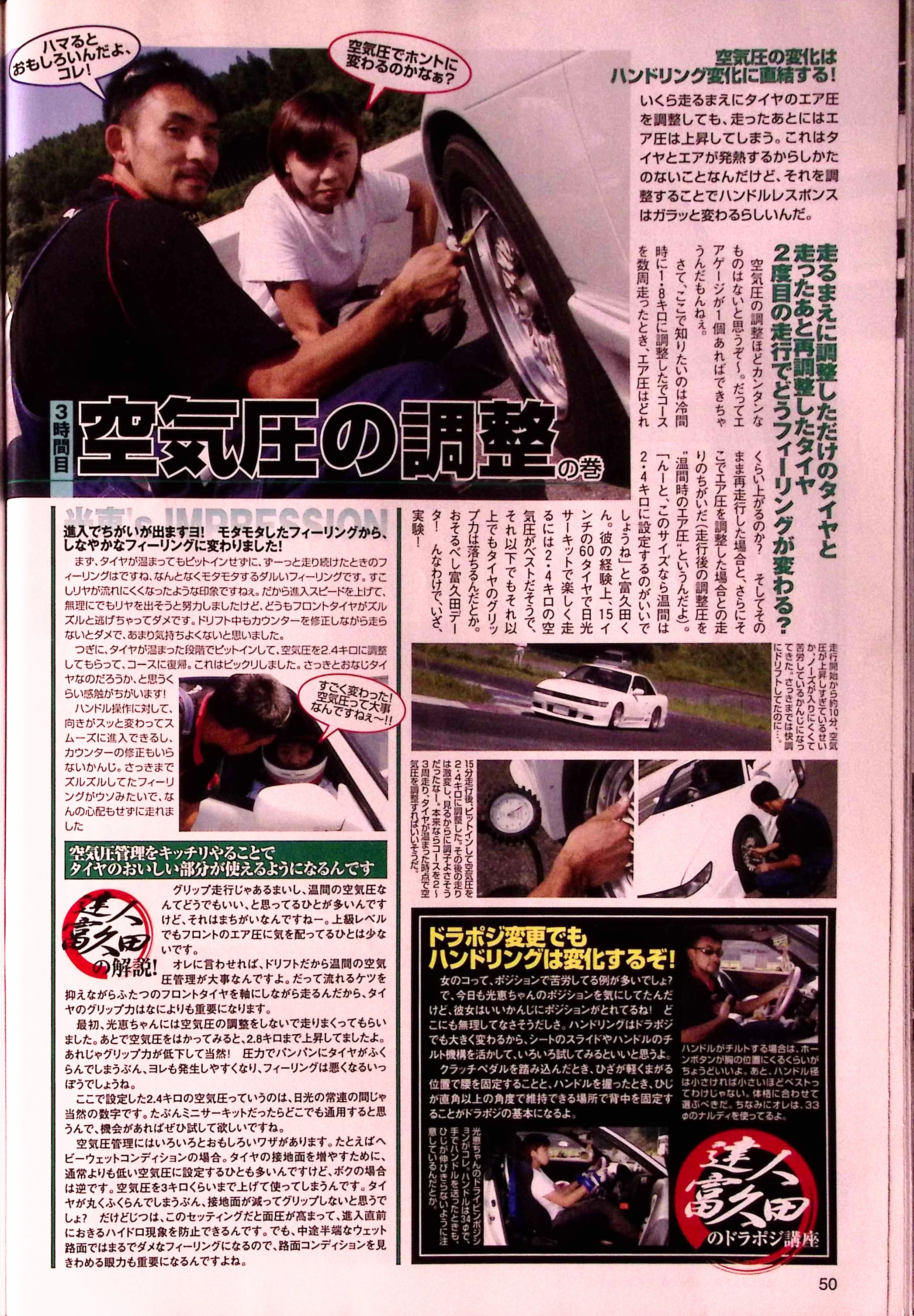
- This is fun…
- …once you get hooked…
- …this!
- Can air pressure really change it?
- Directly changes handling!
- Changes in air pressure…
- Even if tire pressures are set before driving, they rise afterward as the tires and air heat up. Readjusting them apparently changes steering response dramatically. [OCR damaged]
- About ten minutes after starting, the car seems harder to turn in, perhaps because tire pressure has risen too far. It had been drifting smoothly earlier. After driving, reset the pressures and compare the feel on the second run. [OCR interleaves captions]
- Few adjustments are simpler than tire pressure: one pressure gauge is enough! What we want to find out is what happens after starting at a cold pressure of 1.8 kilo… [continued; unit as printed shorthand]
- [Unclear: corrupted fragment]
- [Unclear: clipped fragment]
- [Unclear: corrupted run-related fragment]
- Air-pressure adjustment
- …how far it rises, and the difference between driving again unchanged versus resetting it then. Pressure adjusted after driving is called hot pressure. “For this size, I would set hot pressure to 2.4 kilo…” [continued]
- Lesson 3
- …the lesson
- …says Fukuda. In his experience, 2.4 kilo works best with 15-inch, 60-profile tires for enjoyable driving at Nikko Circuit; higher or lower pressure reduces grip. Remarkable setup data! Now for the experiment. [historical claim; units as printed shorthand]
- Driving impressions: the difference is on entry! It changed from sluggish to supple feel. [heading OCR damaged]
- …the feel was somehow sluggish. The rear seemed less willing to slide, so I tried entering faster and forcing it out. But the front tires slid away and it did not work. During the drift I had to keep correcting countersteer, and it did not feel good. [OCR damaged]
- First, the feel when I kept driving after the tires warmed without coming into the pits…
- …then returned to the course. I was surprised: it felt so different that I wondered whether they were the same tires!
- Next I came into the pits once the tires were warm and had the pressure set to 2.4 kilo…
- In response to steering input…
- It changed so much! Tire pressure really matters!
- After 15 minutes she pitted and the pressure was set to 2.4 kilo. Her driving changed dramatically and visibly improved. Apparently it is normally best to drive three laps and adjust once the tires are warm. [OCR damaged]
- …the car changes direction smoothly and enters easily, seemingly without countersteer corrections. The previous sliding feel seems unbelievable; I could drive without worries…
- …I did. [continued]
- Careful pressure management lets you use the tires’ best operating range
- …does not matter, many people think, but that is wrong. Even among advanced drivers, few pay attention to front pressure…
- “It is not grip driving, so hot pressure…” [continued]
- Explanation!
- [Unclear: isolated character]
- …few do. [continued]
- …pressure management matters. You control the sliding rear while…
- I would say that precisely because it is drifting, hot tire…
- Changing driving position changes handling too!
- …using the two front tires as the pivot, so their grip is more important than anything.
- First, we had Mitsue keep driving without readjusting pressure…
- …but she has a good position! Nothing looks strained. Driving position can greatly change handling, so try different positions using seat travel and steering tilt adjustment. [OCR damaged]
- Women often struggle with driving position, don’t they? I paid attention to Mitsue’s position today…
- …and measured afterward: pressure had risen to 2.8 kilo. Of course grip had fallen! As pressure swells the tire, it apparently also becomes more prone to distortion and the feel worsens. [historical explanation; OCR damaged]
- …fix the hips there, and position the supported back so the elbows retain an angle of at least 90° when holding the wheel. These are the basics of driving position. [OCR damaged; angle wording needs visual review]
- With the clutch fully depressed, the knee should remain slightly bent…
- If the wheel tilts, the horn button should be roughly at chest height. Smaller steering wheels are not always better; choose one to suit your build. I use a 33 [diameter unit omitted] Nardi. [OCR damaged]
- This is Mitsue’s driving position. Her wheel is 34Φ, and she makes sure her elbows do not fully straighten when feeding the wheel through her hands. [OCR damaged]
- …is a familiar figure. It probably works at other small circuits too, so try it when you have the opportunity. [historical recommendation]
- The 2.4-kilo pressure used here is, among Nikko regulars…
- …heavy-wet conditions. Many drivers lower pressure to increase the contact patch, but I do the opposite and raise it to about 3 kilo. You might expect a rounder tire and smaller contact patch to reduce grip, but the higher contact pressure can prevent aquaplaning just before entry. However, on partially wet surfaces it feels terrible, so reading the conditions correctly matters. [historical instructor claim; not independently verified guidance]
- There are various interesting pressure-management techniques. For example, in hea…
- Fukuda [name as OCR]
- The expert’s…
- …driving-position lesson
- 50