Drift Tengoku — October 2003
Drag a corner or click a page to turn it
About this issue
English draft translations are available throughout this issue. Unclear or unreadable OCR remains flagged; these drafts have not received full image proofreading. The archive retains 310 scan files, including two duplicate captures, representing 308 unique pages.
Page 51 · English draft
Draft translation. Unclear OCR remains flagged; full image proofreading has not been performed.
- Thorough [OCR damaged]
- How to build a car that corners
- G!!
- You have adjustable parts, so try adjusting them!
- Various…
- After steering, the rear begins to slide…
- …one beat later! Somehow it feels milder…
- Controllability has definitely changed. In a word, the car seems slower to react to steering inputs.
- Hmm, it is not as dramatic as the toe adjustment earlier. But…
- Lesson 2
- …there is a delay before the rear starts sliding. It is difficult to describe, but I need more steering input than usual to drive the same way. I tried adding more steering, but spun.
- The reason is that on entry, after sharply turning the steering… [OCR damaged]
- Camber adjustment
- Maybe this is what magazines call difficulty getting the nose to turn in…
- …perhaps. The rear tires also lost grip partway through, which I think affected it, but for me this setup was difficult to drive. Maybe more camber is better?
- I did not think it would change the driving this much…
- …I had no idea!
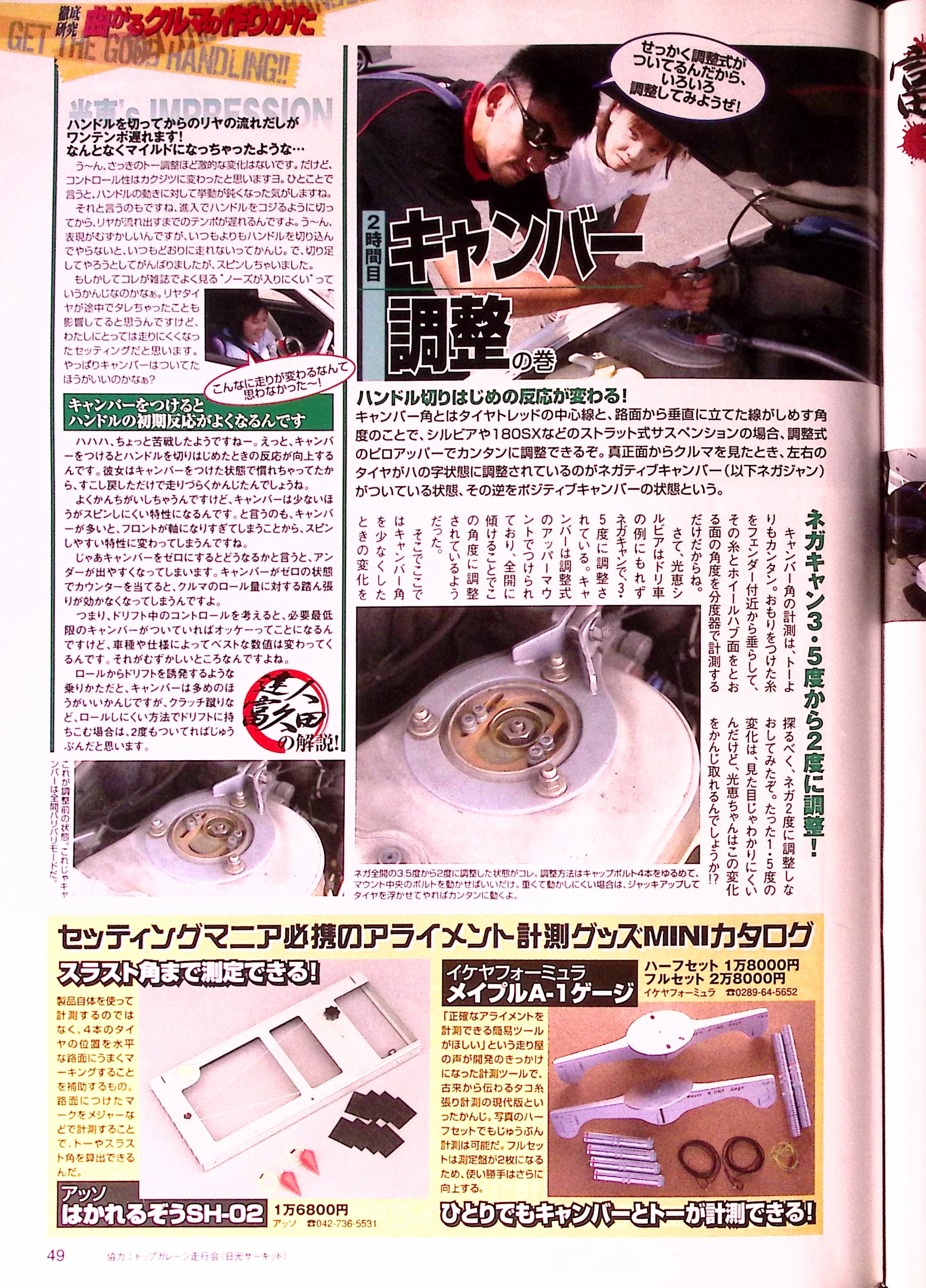
- Initial steering response changes! Camber is the angle between the tire tread’s centerline and a line perpendicular to the road. On strut suspensions such as the Silvia and 180SX, adjustable spherical-bearing upper mounts make it easy to change. Viewed from directly ahead, tires leaning inward at the top have negative camber; the opposite is positive camber.
- …the lesson
- Adding camber improves initial steering response
- Ha ha, you seem to have struggled a little! Well, cam…
- …ber improves response when you first turn the steering. She was used to a cambered setup, so reducing it a little probably made driving feel harder.
- Adjusted negative camber from 3.5° to 2°! Measuring camber is simpler than measuring toe: hang a weighted string near the fender and use a protractor to measure the angle relative to the wheel/hub plane. Mitsue’s Silvia, like many drift cars, has 3.5° negative camber. Adjustable upper mounts appear to give this angle at their maximum tilted position. We decided to explore what happens with less camber… [OCR damaged]
- …makes spinning less likely. With too much camber, the front becomes too strong a pivot and the car can spin more easily. [instructor’s historical claim]
- It is often misunderstood, but less camber…
- …makes understeer more likely. With zero camber during countersteer, the tires cannot resist the car’s roll adequately. [historical explanation]
- What happens with zero camber? Under…
- …necessary camber is enough, but the ideal figure changes with the car and specifications. That is the difficult part.
- So, for control during drifting, the minimum…
- …for that driving style, more camber feels better. But with clutch-kick initiation or other methods involving less roll, I think 2° is sufficient. [OCR damaged; historical claim]
- When initiating a drift through body roll…
- Fuku… [name fragment]
- …we reset it to 2° negative camber to find out. A 1.5° change is hard to see, but will Mitsue feel it?
- …explains!
- …da [name fragment]
- Before adjustment: maximum negative camber. [OCR damaged]
- Here it is after changing from the full 3.5° negative camber to 2°. Loosen the four cap bolts and move the center of the mount. If it is too heavily loaded to move, jack up the car so the tire is off the ground. [OCR damaged]
- Alignment-measuring equipment: mini catalog, essential for setup enthusiasts. Measures thrust angle too!
- Rather than directly measuring with the device, it helps mark the positions of all four tires on a level surface. Measuring those marks lets you calculate toe and thrust angle. [OCR damaged]
- Ikeya Formula Maple A-1 Gauge
- Half set: ¥18,000. Full set: ¥28,000. Ikeya Formula.
- 0289-64-5652
- [Unclear: corrupted equipment caption]
- [email protected] [unrelated-looking OCR string; verify printed source]
- It feels like a modern version of string alignment. Even the half set pictured is sufficient for measurement. The full set has two measuring plates, making it still more convenient…
- ADNG
- aap
- …it can. [continued]
- Asso
- ...easy. SH-02
- ¥16,800
- Measure camber and toe on your own!
- …more convenient. [continued]
- 49
- Assistance: Top Garage driving event (Nikko Circuit) [OCR damaged]
- [Unclear: isolated name/heading fragment]
- 042-736-5531