Drift Tengoku — October 2003
Drag a corner or click a page to turn it
About this issue
English draft translations are available throughout this issue. Unclear or unreadable OCR remains flagged; these drafts have not received full image proofreading. The archive retains 310 scan files, including two duplicate captures, representing 308 unique pages.
Page 50 · English draft
Draft translation. Unclear OCR remains flagged; full image proofreading has not been performed.
- Because it is easy…
- [Unclear: corrupted heading]
- Setup
- Setup techniques you can use at the track!
- You will be fine!
- Can I really do setup adjustments?
- Even I…
- [Unclear: damaged heading fragment]
- Basic course
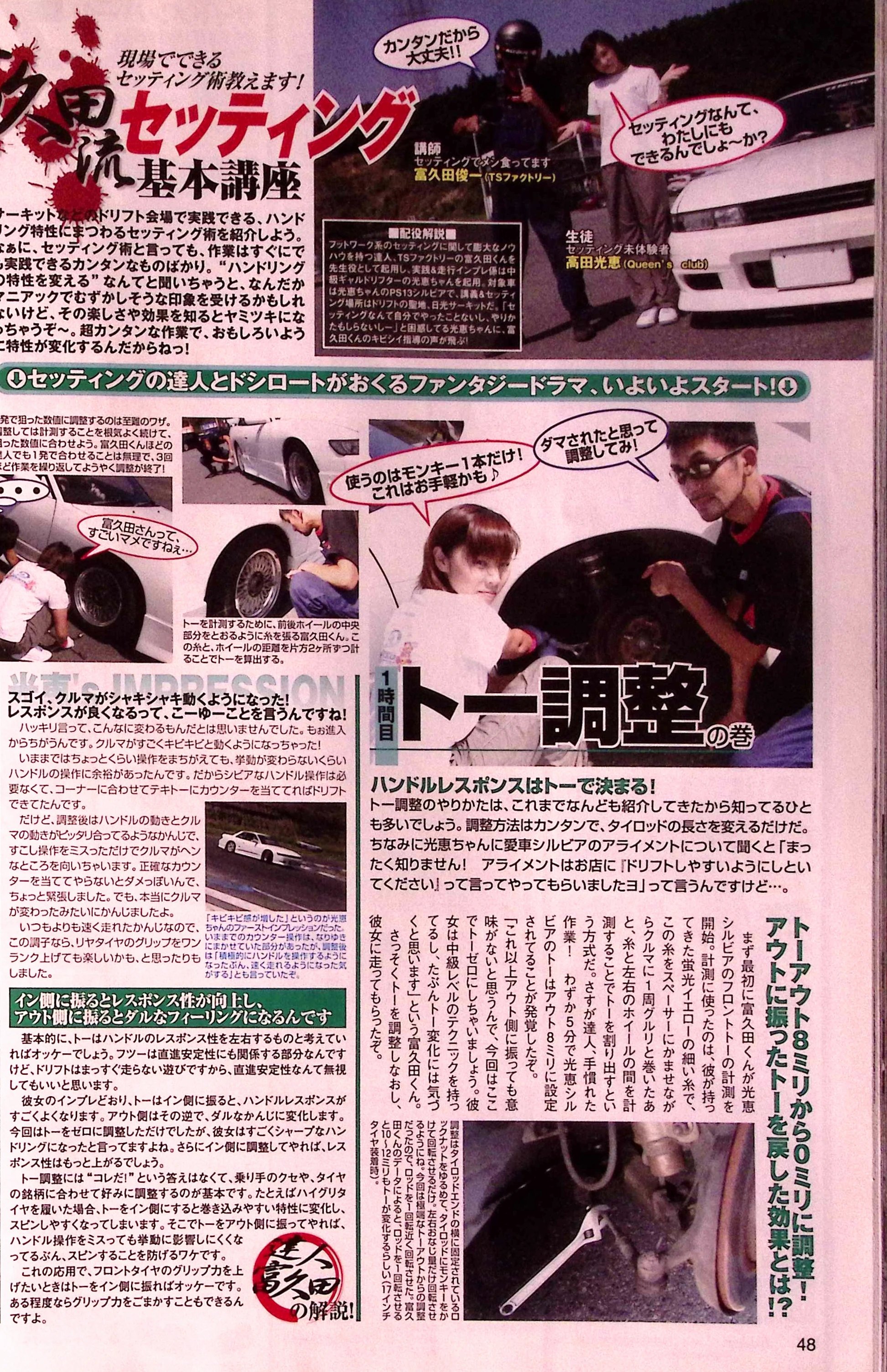
- I make my living doing setups: Shunichi Fukuda (TS Factory) [name/shop OCR readings unverified]
- Instructor
- Here are setup techniques for changing handling characteristics at circuits and drift events. The jobs are all simple and can be done quickly. Changing handling may sound specialized and difficult, but once you discover the fun and effects, you can get hooked. Very simple work can produce surprisingly large changes. [OCR damaged]
- Our instructor is Fukuda of TS Factory, an expert with extensive suspension-setup knowledge. Intermediate female drifter Mitsue will perform the adjustments and driving tests. The car is her PS13 Silvia, and lessons take place at Nikko Circuit, a drifting landmark. “I have never done setups myself and do not know how,” says a bewildered Mitsue, as Fukuda gives strict instructions. [shop/name wording OCR damaged]
- The cast explained
- Student
- Setup beginner: Mitsue Takada (Queen’s club) [given-name reading unverified]
- A fantasy drama starring a setup expert and a complete novice begins!
- Hitting the target figure in one adjustment is extremely difficult. Patiently repeat adjustment and measurement until it matches. Even an expert like Fukuda cannot do it in one try; about three attempts were needed. [opening clipped]
- All you need is one adjustable wrench!
- This might be easy!
- Take my word for it…
- …try adjusting it!
- Mr. Fukuda…
- …you are so meticulous!
- To measure toe, Fukuda stretches string through the centers of the front and rear wheels. Measuring the distance from string to wheel at two points on each side gives toe. [OCR damaged]
- Lesson 1
- Wow, the car moves so crisply now! So this is what improved response means! [opening lettering corrupted]
- ION
- Toe adjustment
- …it feels different right from entry. The car moves much more crisply!
- Honestly, I did not think it could change this much. Even on entry… Before, small mistakes in my inputs did not change the behavior much… [OCR fragment/order requires review]
- …the lesson
- …so there was margin in steering operation. Precise inputs were not necessary; I could drift by applying countersteer roughly to suit the corner.
- Steering response depends on toe! Toe adjustment has been covered here many times, so many readers know it. It is simple: change tie-rod length. Asked about her Silvia’s alignment, Mitsue says, “I know nothing about it! I just asked the shop to make it easy to drift.” [OCR damaged]
- …the car’s movement seems to match the steering exactly, so even a small input mistake points the car somewhere unexpected. I apparently need accurate countersteer, which made me a little nervous. But it really felt like a different car.
- After adjustment, the steering movement and the car… [continued]
- Adjusted from 8 mm toe-out to 0 mm!
- What happens when toe-out is brought back toward zero?
- Fukuda first measured front toe on Mitsue’s Silvia using thin fluorescent-yellow string around the car, measuring the gaps between string and wheels on both sides. His practiced work took only five minutes and revealed 8 mm toe-out. “I do not think there is any point going farther out, so let’s set it to zero. She is intermediate-level and should notice the change,” he said. He then adjusted it and sent her out to drive. The procedure is to loosen the locknut beside the tie-rod end and turn the tie rod with a wrench [rotation-direction wording corrupted]. This large toe-out correction required nearly one full turn. His data indicates one turn changes toe by 10–12 mm with 17-inch tires. [OCR interleaves main text and procedure caption]
- With it like this, I thought it might also be fun to move up one level of rear-tire grip…
- …because it felt as if I could drive faster than usual. That was her first impression. [two column fragments joined]
- Mitsue said the car felt crisper. Previously, some countersteer had been left to the car’s natural behavior; afterward she said she operated the steering more actively and felt able to drive faster. [OCR damaged]
- [Unclear: isolated character]
- [email protected] [unrelated-looking OCR string; verify printed source]
- …done.
- Moving toward toe-in improves response; moving toward toe-out makes the feel slower. [historical setup claim; review against source]
- …that is a useful way to think about it. Toe normally also affects straight-line stability, but drifting is an activity where you do not drive straight, so I think straight-line stability can be disregarded. [historical instructor quotation, not independently verified advice]
- Basically, think of toe as a factor governing steering response…
- …improves considerably. Toe-out does the opposite, making it slower. We only set toe to zero here, yet she says handling became much sharper. More toe-in would probably increase response further. [historical claim]
- As her impressions show, moving toe inward improves steering response…
- [Unclear: corrupted heading fragment]
- There is no single correct toe setting. It should suit the driver’s habits and tire…
- …brand and personal preference. For example, with grippy tires, toe-in can make the car turn inward more readily and spin more easily. Toe-out makes small steering mistakes less influential on behavior, helping prevent spins. [OCR damaged; instructor’s historical claim]
- …increase it by moving toe inward. To some extent, you can compensate for grip this way…
- As an application of this, to increase front-tire grip…
- [Unclear: isolated character]
- …you can. [continued]
- …explains!
- 48